Talk to Sales
Strategic Playbook for Centralizing Billing Across a Multi-Site Healthcare Organization
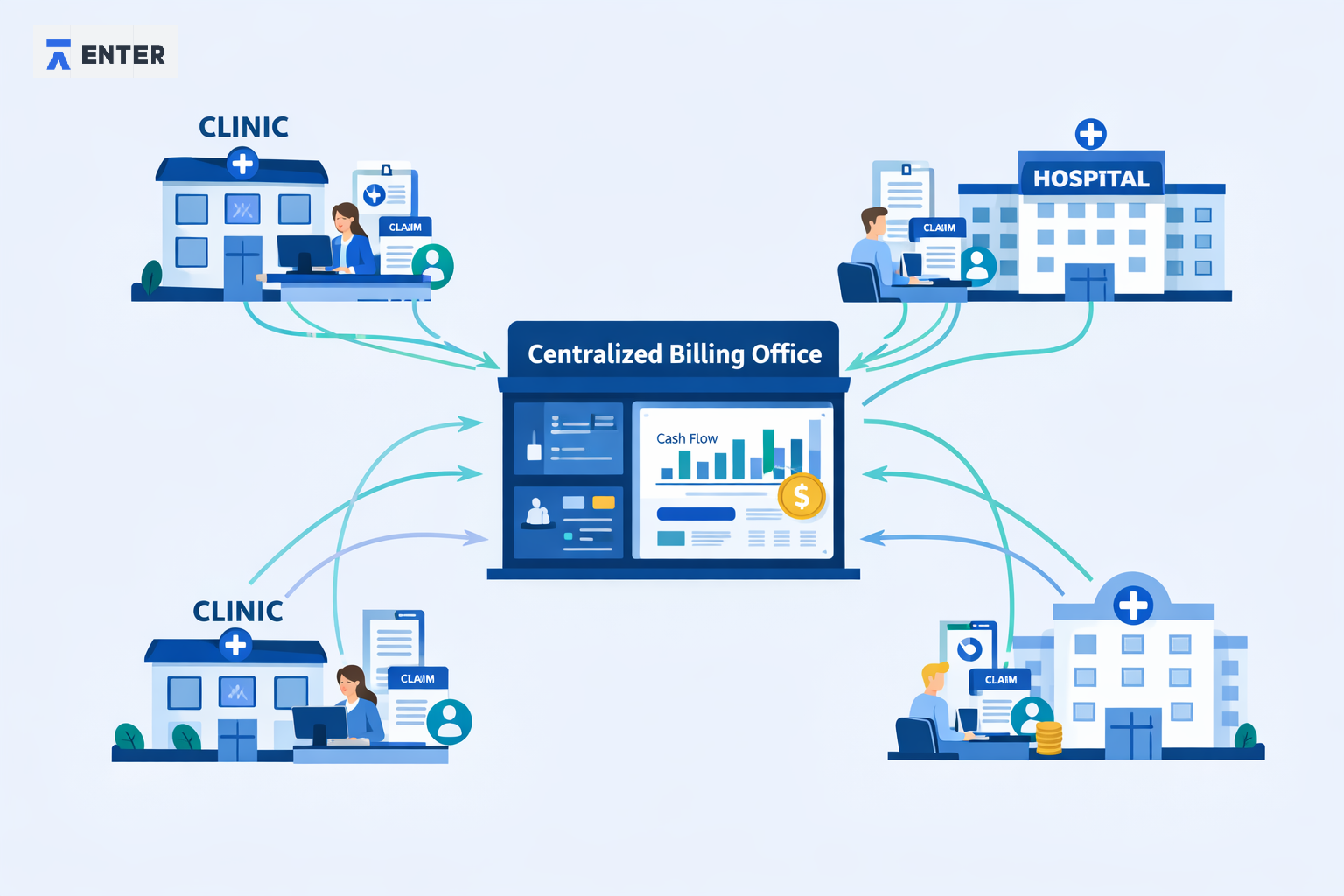
Consolidating billing across multiple healthcare locations requires significant planning and resources. For leaders managing scattered data and redundant workflows, centralization delivers measurable ROI through improved cash flow and reduced administrative overhead.
Enter Health's unified platform accelerates reimbursements across all locations by automating claim submission, reducing denials, and providing real-time payment visibility, getting your entire network paid faster.
Moving from independent clinics to one unified model fixes the rising costs and reporting problems that come with growth. CFOs and Revenue Cycle Directors now recognize centralization as essential. The challenge lies in implementing it without disrupting daily operations.
How Enter Health's AI-powered platform enables centralized billing operations is the focus of this playbook. Enter Health's platform provides the technology infrastructure to centralize billing operations, standardizing workflows across sites automatically, eliminating manual process mapping.
We will explore how to combine data and deploy the right AI technology to maintain control across all your locations. Understanding this roadmap is the first step toward turning a fragmented billing operation into a strategic advantage.
Key Takeaways
- Centralized billing powered by AI removes duplicate teams and manual work across multiple sites.
- A single data platform turns scattered information into one source of truth with real-time visibility.
- Enter Health's ClaimAI detects billing errors across all locations before submission, resolving the root causes of denials and boosting cash flow.
What Is a Centralized Billing Office in Healthcare?
A Centralized Billing Office (CBO) pulls together revenue cycle work from multiple facilities into one team, according to the Healthcare Financial Management Association (HFMA) [4]. Instead of each clinic running its own billing staff and handling its own payer contracts, a CBO manages everything from one place. This gives you better visibility, more consistency, and greater efficiency across your whole organization.
Fragmentation usually happens through growth. When a health system buys independent physician groups, those groups often keep using their own EHRs and billing processes. This creates disconnected financial data that makes system-wide reporting difficult and costly.
The impact of optimizing revenue cycle operations is well-documented. Evidence from highly optimized revenue cycle operations suggests that extending automation and workflow improvements to all hospitals and physician groups could reduce administrative spending by 15–20%, representing $15–$20 billion annually [1].
When clinical and financial data are unified, the gains compound: Mayo Clinic's experience consolidating data from 70 care sites into a single longitudinal data store demonstrates how centralized infrastructure reduces complexity and enables more consistent operational performance across a large system. [5]
Core Components of a Centralized Billing Office
- One team for all revenue work: Combine hospital and clinic billing to eliminate duplicate efforts.
- Central claims management: Send and track all claims through a single system powered by AI.
- Standard payer processes: Ensure every location handles denials and appeals uniformly.
- One reporting dashboard: Give leadership a single screen to track performance across all sites continuously.
The Financial Case for Centralized Billing
Centralized billing cuts duplicate work, improves reporting accuracy, and enables growth without proportional staffing increases. HFMA and FinThrive's Revenue Cycle Maturity Assessment found that organizations with higher automation maturity consistently outperform peers on A/R management and collection rate efficiency. [2]
Real-world results support this. Proliance Surgeons, a 400-provider, 90-location multi-specialty group, consolidated from seven disparate claim submission methods into a unified workflow, gaining real-time claims visibility and dramatically reducing the time between claim submission and follow-up action. [3]
For health systems running platforms like Epic, centralization gives you the structure to standardize how data gets captured at the front end. That directly improves back-end billing accuracy.
Key Benefits of Centralization
- Full financial visibility across every location.
- A consistent billing experience for patients regardless of where they receive care.
- Reduced manual effort through unified payment portals.
- Higher productivity from billing teams with specialized roles.
- Faster revenue cycle close with real-time data.
Why Do Multi-Site Organizations Struggle With Fragmented Billing?
Fragmented billing happens when hospitals and clinics run their own systems, workflows, and reports. This leads to inconsistent data and higher costs. The root cause is typically past growth. As health systems buy new practices, they inherit the technology those practices already use.
A large health system might have many different EHR and practice management systems across its locations, each with its own way of recording data.
Common Sources of Fragmentation
- Different EHR systems across sites, like a mix of Epic, Cerner, and older platforms that lack interoperability.
- Billing workflows built over years by local staff that vary significantly from place to place.
- Separate payer relationships where each location negotiates its own contracts.
- Disconnected payment portals where staff must log into multiple websites to post payments.
The results are painful. You end up with duplicate billing teams performing identical tasks in different places. Payment posting gets delayed because remittance data arrives in different formats and must be matched manually. Compliance becomes spotty because each site interprets rules in its own way. Worst of all, leadership has no clear view of what is working and where money is leaking.
Fragmented billing forces organizations to maintain separate accounting systems for each location, preventing leadership from accessing consolidated financial data or identifying system-wide trends. Leaders are forced to make decisions based on incomplete information.
Building a Unified Centralized Billing Strategy

Credits: unsplash.com (photo by National Cancer Institute)
A robust centralized billing strategy relies on standard workflows, unified data, central reporting, and integrated payment systems. These components work together to turn a collection of independent billing offices into one high-functioning revenue cycle operation.
Standard Workflows
Before deploying technology, align your human processes. Shared billing protocols mean every coder and biller follows the same steps regardless of the facility they support. Central claims management ensures all claims go through one clearinghouse and are measured against identical targets.
Consistent payer communication means when denial patterns emerge, you address them across the whole system instead of clinic by clinic.
MGMA's 2024 benchmarking data found that more than half of U.S. healthcare organizations report denial rates exceeding 10%, and MGMA guidelines identify 45 days or less as the benchmark for days in A/R, giving practices with standardized RCM workflows a measurable performance target. [3]
Data Consolidation
Standard workflows produce data, but that data is useless if it sits in separate silos. To unite patient financial data, you need a platform capable of pulling information from numerous source systems and harmonizing it.
You also need standard reporting definitions so that a denial means the same thing at a hospital as it does at a clinic. Then you can build enterprise dashboards that give leaders a real-time view of cash flow, AR days, and denial rates across the whole organization.
Payment Systems
The final piece is the system that moves money. Consolidated remittance data means payments and explanations of benefits from all payers flow into one place.
Electronic document management in healthcare organizes and secures payment records across all locations, creating a searchable archive for compliance and auditing. Central payment processing lets you control how and when funds hit your account.
Unified patient billing means a patient gets one clear bill no matter how many different services they received across your system.
How Does Technology Help With Centralized Billing?
Technology makes centralized billing possible by connecting different EHR and billing systems into one platform. This platform standardizes financial data and automates revenue cycle work. Enter Health's platform eliminates the need for manual workflow standardization, our AI learns from your best-performing sites and automatically applies those patterns across your network.
Integration platforms act as the connector, linking older systems to modern RCM tools without forcing you to rip out your clinical EHR.
Enter's platform supports automated medical claims processing, which reduces errors and speeds up the entire billing cycle by eliminating manual data entry.
Essential Technology Capabilities
- Connection tools to link all your source systems.
- Enterprise billing analytics to track performance across sites.
- Clearinghouse connections to manage all claims through one pipeline.
- Payment platforms that automatically post remittances.
How the Right Stack Delivers
- Displays real-time financial data so you know your cash position instantaneously.
- Tracks claims across sites so a denial at one clinic teaches all clinics.
- Automates payment reconciliation, eliminating the need for spreadsheets.
- Posts remittances in one workflow whether they are electronic or paper.
What Is a Canonical Data Model and Why Does It Matter?

Credits: unsplash.com (photo by Campaign Creators)
A canonical data model takes financial and operational data from many different EHR systems and maps it into one standard structure. This enables consistent reports and analysis across all your facilities.
It is the technical foundation of any successful centralization effort. Large health systems often need to connect dozens of different EHRs during consolidation, each recording patient details, charge codes, and payer information in its own proprietary format.
The canonical model acts as a translator. It takes data from systems like Epic, Cerner, and NextGen and maps them into a standard format your central data warehouse can understand. This follows standards like HL7 but goes further to create a consistent view of your revenue cycle.
Benefits of a Canonical Model
- Systems can connect without forcing every clinic to replace their EHR.
- Financial metrics are standardized to allow true comparisons.
- Enterprise analytics provide a complete system-wide view.
- New practices can onboard faster because the translation framework already exists.
For example, if one EHR uses "1200" for a level three visit and another uses "99213," the canonical model maps both to a single definition so your reports show accurate charge volumes.
What Gains Come From Consolidated Billing Services?
Consolidated billing improves cash flow, lowers administrative costs, and gives leaders financial visibility across all sites. These gains transform how your revenue cycle performs.
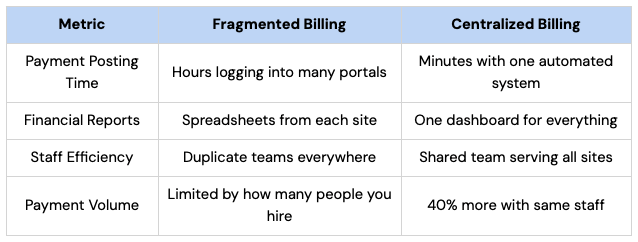
Large multi-specialty groups also see significant improvements in denial management. Our denial management system provides unified visibility into denial patterns across your entire network. Specialized teams can focus on specific payers, getting better at appeals and winning more often.
Large payers actively incentivize streamlined billing. UnitedHealthcare's provider portal explicitly recommends electronic and API-based billing workflows, noting that fewer returned claims mean faster payments and better efficiency, a clear signal that organized, centralized submission improves the provider-payer relationship. [6]
Other benefits include less revenue lost to claims that fall through cracks, an improved patient experience through consolidated billing, and stronger compliance because policies apply uniformly.
To understand how all these pieces fit together, a clear healthcare revenue cycle flowchart helps teams visualize each step from patient registration to final payment.
What Technology Stack Supports Unified Healthcare Management?
Unified healthcare management systems combine AI revenue cycle software, connection tools, analytics, and payment networks into one setup that supports centralized billing. The stack must handle the complexity of multi-site operations without creating new problems.
Healthcare organizations spend about $39 billion each year on administrative complexity [7]. Much of that comes from manual workarounds needed for disconnected systems. A modern stack eliminates that waste. Customer relationship management platforms that sit on top of older systems give staff one place to manage patient financial interactions.
The Layers of a Modern Stack
- Connection layer: Links EHRs and practice management systems to your central platform using APIs and HL7 interfaces.
- Data layer: Holds the canonical data model and data warehouse that standardizes information for reporting.
- Workflow layer: Contains billing automation, claims management, and denial tools that staff use daily.
- Analytics layer: Provides dashboards and KPI tracking that give leaders visibility across all sites.
How ENTER Makes Centralized Billing Possible
ENTER connects existing systems and consolidates revenue cycle data into a single platform, giving leaders real-time visibility across all locations. We built ENTER for the complexity of multi-site health systems. Enter Health's real-time analytics dashboard shows exactly how billing and collections are performing across every location, updated continuously, no more waiting for month-end reports.
Our technology connects to any source system. It uses a canonical data model to turn scattered data into one unified structure. This provides leaders a single source of truth without expensive, multi-year replacement projects. Centralized payment networks inside ENTER cut payment posting time by 50%. Enter Health's ClaimAI detects billing errors across all locations before submission, resolving the root causes of denials.
Technology Capabilities
- Connects to Epic, Cerner, NextGen, and dozens of other systems.
- Matches payments to claims automatically using AI.
- Shows real-time performance across all locations in one dashboard.
- Onboards new facilities in weeks instead of months.
Key Operational Benefits
- Faster financial close because data is clean and immediately accessible.
- Consistent billing across all sites, which patients appreciate.
- A revenue cycle that scales as you grow without adding proportional overhead.
Building a Centralized Billing Operation That Grows With You
Centralized billing turns scattered operations into a system that supports growth, acquisitions, and data-driven decisions. Health systems that pursue operational systemness see real efficiency gains. The AI infrastructure required to centralize pays for itself many times over.
Systemness is not about forcing uniformity just to be uniform. It is about creating the conditions for smart growth. When a health system acquires a new practice, a centralized billing operation lets them plug that practice into existing workflows immediately.
Long-Term Advantages
- Financial transparency that guides smart investment decisions.
- Fast onboarding that accelerates the value of new acquisitions.
- Quicker decisions based on real-time data instead of outdated reports.
Healthcare organizations that centralize billing move from isolated operations to an AI-driven enterprise. They can predict problems and spot opportunities early. For leaders building organizations that last, that visibility is the ultimate advantage.
Frequently Asked Questions
What happens to my medical bills if I need care at multiple locations?
Your medical bills usually come from one central billing office after your insurance processes the claims. You may receive separate bills for the facility and physician services, but one centralized billing office handles all inquiries and payment questions.
How do I know if my insurance covers a specific medical test?
Call your insurance company before your visit to check your coverage. Ask about deductibles and copays for specific medical tests. This helps you avoid surprise bills later.
Can I set up a payment plan for my medical bills?
Yes, contact the billing office right away to ask about monthly payment plans or financial assistance based on your income. They want to help you manage the cost.
Why does my explanation of benefits differ from what I owe?
Your explanation of benefits shows what your insurance paid. The bill shows what you still owe after that payment. Contact the billing office if the amounts don't match your expectations or if you need clarification.
What if I get a bill for a service I thought was covered?
Call the billing office to understand why. They may resubmit the claim to your insurance. You can also appeal the decision with your insurance company directly.
Centralized Billing That Actually Supports Growth
Disconnected billing systems wear you down fast. You chase numbers across platforms, fix manual errors, and still struggle to see the full revenue picture. It slows decisions and drains your team's time.
ENTER connects existing systems and consolidates revenue cycle data into a single platform, giving leaders real-time visibility across all locations. No major system replacement, no long disruption to daily work. You gain immediate transparency and centralized control, empowering your organization to focus on scaling and patient care instead of fixing billing errors.
References
- https://pmc.ncbi.nlm.nih.gov/articles/PMC10986268/
- https://www.hfma.org/revenue-cycle/benchmark-tool-for-revenue-cycle-automation-finds-some-success/
- https://www.mgma.com/mgma-stat/strategic-improvements-in-your-rcm-to-reduce-your-practices-claim-denials
- https://www.hfma.org/revenue-cycle/patient-financial-communications/62489/
- https://www.ncbi.nlm.nih.gov/books/NBK594445/
- https://www.uhcprovider.com/en/claims-payments-billing.html
- https://www.hfma.org/legal-and-regulatory-compliance/u-s-hospitals-can-no-longer-afford-the-burden-of-administrative/
Related Articles
Results
Sources
About the Author


ENTER is HIPAA compliant and SOC 2 Type 2 certified. See our trust center to learn more.