Talk to Sales
ENTER vs. Waystar: 2025 RCM Platform Showdown

Choosing a Revenue Cycle Management (RCM) platform is one of the most critical financial decisions a healthcare practice can make. The right partner can accelerate revenue, reduce administrative burdens, and provide the data needed for strategic growth. Two of the most prominent names in the RCM space today are ENTER and Waystar. Both offer powerful, technology-driven solutions, but they approach the problem from different angles.
This article provides a comprehensive comparison of ENTER and Waystar, examining their core features, technological approaches, and key differentiators to help you determine which platform is the best fit for your practice's unique needs.
Quick Comparison
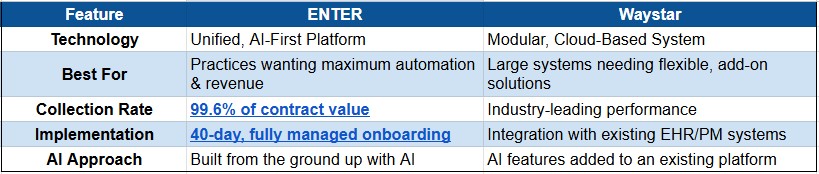
- Choose ENTER if: You want a fully automated, AI-first system that guarantees a high collection rate and gets you set up fast with a single, unified platform.
- Choose Waystar if: You're a large health system that needs a flexible, modular system to add specific tools to your existing infrastructure.
At a Glance: ENTER vs. Waystar
Deep Dive: What is ENTER?
ENTER is an AI-first RCM platform built to be a single, end-to-end solution for your entire revenue cycle. Its core philosophy is to replace the fragmented, multi-vendor approach that plagues many practices.
- A Truly Unified System:
- ENTER's platform is designed to replace up to 10 different RCM vendors, streamlining your operations and dramatically reducing complexity.
- This means you have one system, one login, and one source of truth for all your billing data, from patient registration to final payment.
- This eliminates data silos, which are a primary source of billing errors and revenue leakage.
- The Power of an AI-Native Engine:
- claimAI: This isn't just a claim scrubber. It's an AI engine that automates the creation of "perfect claims" by validating them against a massive database of payer rules in real-time. It catches errors before they ever become denials.
- denialAI: For the small fraction of claims that do get denied, this AI engine automates the appeal process, using programmatic follow-up to ensure every claim is pursued to resolution.
- paymentAI: Automates payment posting from both ERAs and paper EOBs in seconds, eliminating a tedious and error-prone manual task.
- The End Goal: ENTER's mission is to create a billing process that is so automated and accurate that it becomes invisible, allowing your staff to focus on high-value tasks and patient care.
Deep Dive: What is Waystar?
Waystar is a large, established RCM provider that offers a comprehensive suite of tools to manage the revenue cycle. They are a major player in the industry with a long history and a large, diverse customer base.
- A Modular, Flexible Approach:
- Waystar's strength lies in its modularity. You can pick and choose the specific tools you need to augment your existing systems.
- This is ideal for large organizations with complex, established IT infrastructure who aren't ready for a full system replacement but need to solve specific problems, like prior authorization or patient payments.
- Modules include solutions for Financial Clearance, Claim Management, Payment Management, and Patient Financial Experience.
- Integrating and Enhancing AI:
- Waystar is designed to work with a wide variety of existing EHR and practice management software, making it easier to adopt their tools without a major overhaul.
- They have been making significant investments in AI, especially with their AltitudeAI™ platform and the acquisition of Iodine Software in October 2025.
- Their AI strategy focuses on enhancing existing workflows with predictive analytics, helping to identify potential issues before they lead to denials.
Performance & ROI: The Financial Impact
When it comes to performance, both companies offer impressive results, but they focus on different key metrics.
ENTER's ROI Focus:
- 99.6% Collection Rate: This is a standout metric. For a practice with $10 million in annual billings, improving the collection rate from an average of 95% to 99.6% translates to an additional $460,000 in revenue per year.
- 40-Day Implementation: In the world of healthcare IT, where implementations can often take 6-12 months, a 40-day go-live is incredibly fast. This rapid deployment means you start seeing a return on your investment in weeks, not months or years.
Waystar's Performance Focus:
- Strong Market Growth: Waystar's reported 12% year-over-year revenue increase in Q3 2025 demonstrates their strong market position and ability to deliver results for a large and diverse client base.
- Deep Analytics and Insights: Their tools provide detailed dashboards and reporting to help you find and fix inefficiencies in your revenue cycle. This data-driven approach can be very valuable for large practices looking to optimize their complex workflows and make incremental improvements.
Implementation: Getting Started
The process of implementing a new RCM platform is a critical factor to consider.
- ENTER's Fully Managed Onboarding:
- ENTER offers a white-glove, fully managed 40-day implementation.
- Their team handles the entire process: EHR integration, clearinghouse enrollment, payer contract loading, and staff training.
- This significantly reduces the burden on your internal IT and administrative teams.
- Waystar's Integration-Focused Setup:
- Waystar's implementation process is focused on integrating their modules with your existing systems.
- While they have a strong integration team, this process often requires more involvement from the practice's own IT staff to manage the connections between the different systems.
Frequently Asked Questions
How does pricing work?
Both companies offer customized pricing based on the needs of the practice. ENTER typically charges a percentage of collections, which aligns their success with the practice's financial performance. For detailed information, it's best to visit the ENTER pricing page or contact Waystar directly.
Which platform is better for a small, independent practice?
While both platforms can serve practices of all sizes, ENTER’s fully managed, end-to-end solution and rapid implementation can be particularly beneficial for smaller practices with limited IT resources. The all-inclusive nature of the platform simplifies vendor management and reduces the need for a large in-house billing team.
Can I integrate my existing EHR with these platforms?
Yes, both platforms offer robust EHR integration capabilities. Waystar has a long history of integrating with a wide range of EHR and PM systems. ENTER provides a fully managed, custom integration with any EHR, ensuring a seamless data flow without requiring significant effort from the practice’s IT team.
Conclusion: Making the Right Choice for Your Practice
Both ENTER and Waystar offer compelling solutions for healthcare practices looking to optimize their revenue cycle. The best choice depends on your practice's specific priorities and existing infrastructure.
If your primary goals are to maximize your collection rate, achieve a fast ROI with a fully managed implementation, and leverage a single, unified, AI-native platform to handle everything, ENTER is likely the stronger choice.
If you are a large health system with a complex web of existing systems and are looking for a modular, highly customizable RCM solution from an established industry leader to solve specific problems, Waystar may be a better fit.
Ready to see how an AI-first RCM platform can change your practice? Request a demo from ENTER today.
Results
Sources
About the Author


ENTER is HIPAA compliant and SOC 2 Type 2 certified. See our trust center to learn more.