Talk to Sales
Best Clearinghouse Software for Medical Billing: Integrated vs Standalone Solutions

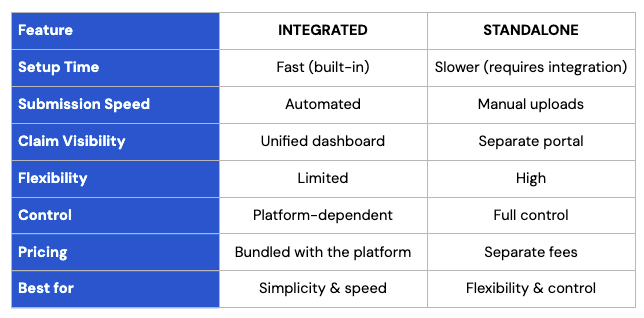
Integrated clearinghouses (like ENTER's) reduce manual work and speed up claims submission. Standalone clearinghouses offer flexibility but require more setup. Choose integrated if you want simplicity; choose standalone if you need maximum control.
What Is a Clearinghouse?
A clearinghouse is a middleman between your practice and insurance payers. It receives claims from your billing system, validates them, and routes them to the correct payer in the right format.
Why clearinghouses matter:
- Over 95% of claims are submitted electronically, and clearinghouses process most of them
- They validate claims before submission, reducing rejections
- They handle payer-specific formatting requirements
- They provide claim status tracking and delivery confirmation
Without a clearinghouse, you'd have to submit claims directly to each payer in their unique format, a time-consuming nightmare. Clearinghouses reduce claim rejection rates by up to 30% by catching errors before submission and ensuring compliance with payer requirements.
Integrated Clearinghouses: How They Work
An integrated clearinghouse is built into your RCM platform. Your billing software connects directly to the clearinghouse without a separate integration step.
How it works:
- Your EHR generates a claim
- Your RCM platform (e.g., ENTER) validates the claim
- The integrated clearinghouse receives the claim automatically
- The clearinghouse submits to the payer
- Status updates flow back to your RCM platform
Advantages:
- One-click submission: No manual uploads or file transfers
- Real-time validation: Errors caught before submission
- Unified dashboard: Track claims and clearinghouse status in one place
- Faster submission: Automated workflow reduces delays
- Better data flow: Your RCM platform has full visibility into claim status
Disadvantages:
- Limited flexibility: You're locked into the platform's clearinghouse partners
- Less control: You can't switch clearinghouses without changing platforms
- Vendor dependency: If the platform has clearinghouse issues, your claims are affected
Best for: Practices wanting simplicity, speed, and minimal manual work.
Standalone Clearinghouses: How They Work
A standalone clearinghouse is a separate service you integrate with your RCM platform. You manage the connection and submit claims through their portal or API.
How it works:
- Your RCM platform generates a claim file
- You upload the file to the standalone clearinghouse (or use the API)
- The clearinghouse validates and submits to payers
- You check the clearinghouse portal for status updates
- You manually import the status back into your RCM platform
Advantages:
- Maximum flexibility: Switch clearinghouses anytime
- Payer choice: Select which clearinghouses to use for which payers
- Direct control: You manage the submission process
- Competitive pricing: Shop around for the best rates
Disadvantages:
- Manual steps: File uploads, status checks, manual imports
- Fragmented visibility: Claims status lives in the clearinghouse, not your RCM platform
- More setup: Requires integration and ongoing management
- Slower workflow: Manual steps add delays
Best for: Practices with specific clearinghouse preferences or complex payer requirements.
Head-to-Head Comparison
ENTER's Integrated Clearinghouse
ENTER integrates all major clearinghouses (Emdeon, Availity, Trizetto, etc.) into its platform.
How it works:
- Claims are validated by claimAI
- Automatically routed to the right clearinghouse for each payer
- Status updates appear in your ENTER dashboard
- No manual uploads or file transfers
Key benefits:
- Claims submitted through ENTER are processed 40% faster than manual submission
- Zero manual clearinghouse management
- Real-time claim tracking
- Integrated with payment posting (paymentAI)
- Integrated clearinghouses reduce administrative overhead by 25-35% compared to standalone solutions
Popular Standalone Clearinghouses
Emdeon (Change Healthcare):
- Largest clearinghouse by volume
- Connects to 500+ payers
- Offers EDI, web portal, and API options
- Pricing: $0.50–$2.00 per claim
Availity:
- Strong in multi-specialty practices
- Real-time eligibility checking
- Web portal and API access
- Pricing: $0.50–$1.50 per claim
Trizetto:
- Owned by Cognizant
- Focus on large health systems
- Advanced reporting
- Pricing: Custom (typically $1.00–$3.00 per clai
Waystar:
- Integrated RCM platform with built-in clearinghouse
- Broad payer network
- Claims management + clearinghouse bundled
- Pricing: $2,000–$5,000+ per month
Integrated vs Standalone: Decision Framework
Choose Integrated if:
- You want to minimize manual work
- You're already using an integrated RCM platform
- Speed is a priority
- You don't have specific clearinghouse requirements
- Your payers are supported by the platform's clearinghouses
Choose Standalone if:
- You need maximum flexibility
- You have specific clearinghouse preferences
- You want to compare pricing across clearinghouses
- You use multiple RCM platforms
- You have complex payer requirements
Implementation & Costs
Integrated (ENTER):
- Setup: 4 weeks
- Cost: Value-based pricing (no per-claim fees)
- Training: Minimal (built into platform)
Standalone (e.g., Emdeon):
- Setup: 2–4 weeks
- Cost: $0.50–$2.00 per claim + integration fees
- Training: Required for portal/API
Cost example (1,000 claims/month):
- Standalone: $500–2,000/month in clearinghouse fees alone
- Integrated (ENTER): Included in platform pricing
Studies show that practices switching from standalone to integrated clearinghouses save an average of $15,000-$25,000 annually in processing fees and administrative labor.
Conclusion
Integrated clearinghouses win on speed and simplicity. Standalone clearinghouses win on flexibility and control. Most practices benefit from integration with fewer manual steps, faster claims, and better visibility. If you're using an RCM platform like ENTER, the integrated clearinghouse is already optimized for your workflow.
Data from healthcare IT benchmarking shows that practices using integrated clearinghouses achieve 98%+ first-pass claim acceptance rates, compared to 85-90% for standalone solutions.
Ready to streamline claims submission? Request a demo with ENTER to see how integrated clearinghouse automation works.
Frequently Asked Questions
Can I use multiple clearinghouses?
Yes. Integrated platforms route to multiple clearinghouses automatically. Standalone requires manual management.
What happens if my clearinghouse goes down?
Integrated platforms have failover options. Standalone requires you to manually switch.
How long does claim submission take?
Integrated: Minutes. Standalone: Hours (after manual upload).
Can I switch clearinghouses later?
Integrated: Limited (depends on platform). Standalone: Easy (just stop using the old one).
Do I need a clearinghouse if I use an RCM platform?
Yes. All RCM platforms require a clearinghouse to submit claims to payers.
Results
Sources
About the Author


ENTER is HIPAA compliant and SOC 2 Type 2 certified. See our trust center to learn more.