Talk to Sales
Revenue Cycle Service Centers: How Centralized Billing Fixes Cash Flow
Most billing problems aren't billing problems. They're coordination problems — a front desk that doesn't know what a coder needs, a denial team that can't reach the documentation it needs to appeal, a biller working from information that's already three steps stale. The errors are symptoms. The system is the cause.
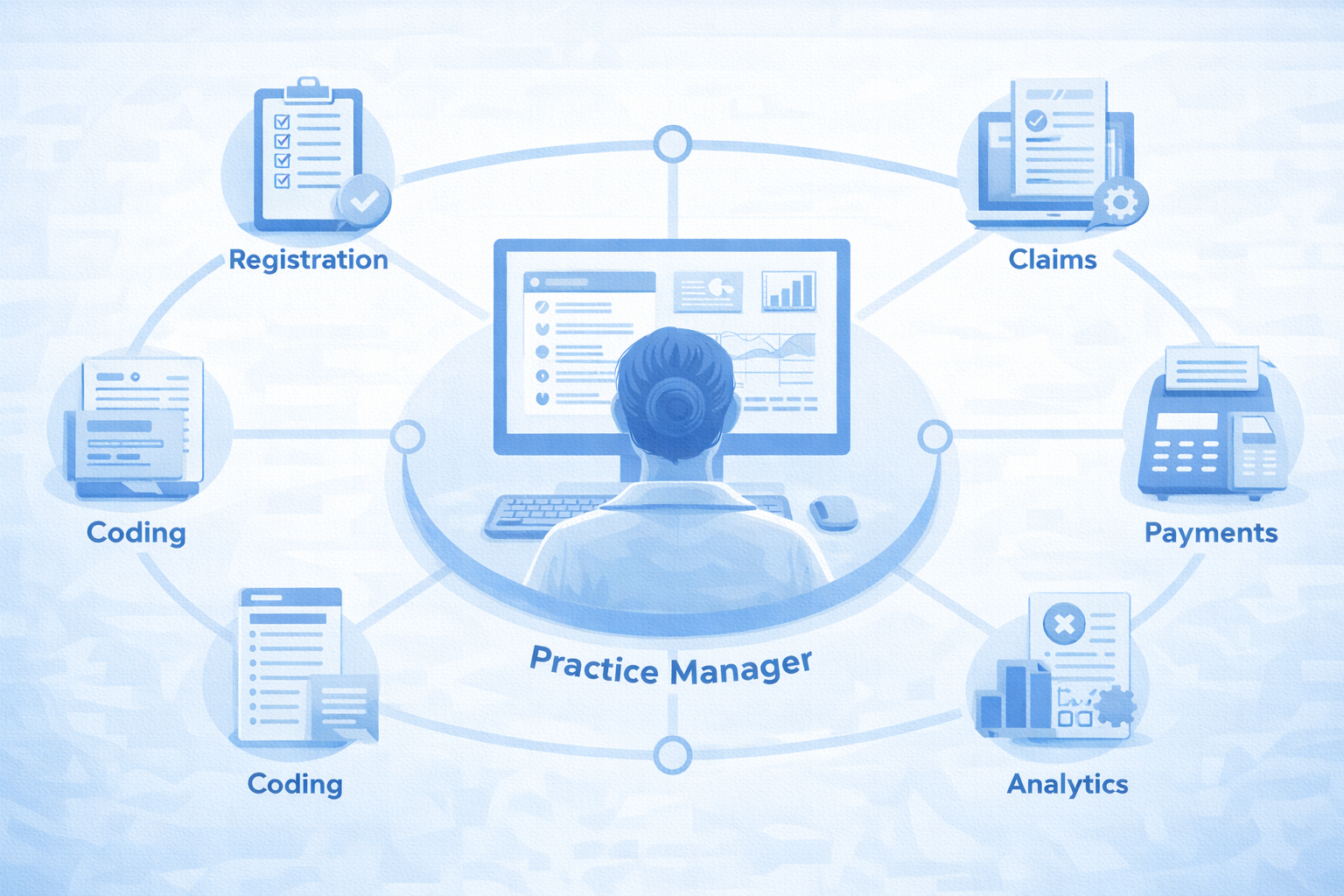
A revenue cycle service center addresses the root issue: it consolidates every financial function — registration, coding, claims, payment posting, denials, patient billing — into one operation working from one source of data. For practice managers dealing with unpredictable cash flow and mounting AR balances, that's not an incremental improvement. It's a structural fix.
CTRL ENTER is built to power exactly this model: a centralized financial hub that brings order to the process from appointment to payment.
What Is a Revenue Cycle Service Center?
A revenue cycle service center is a dedicated operation that manages the complete financial lifecycle of a healthcare practice. It's not a billing department with a fancier name. It's a centralized hub where patient registration, medical coding, claims submission, payment posting, denial management, and patient financial services all operate from shared data, aligned workflows, and unified accountability.
The distinction matters. In most in-house billing setups, these functions sit in silos — separate staff, separate systems, often separate floors. Information passes between them through manual handoffs, and each handoff is a place where errors get introduced, context gets lost, and time gets wasted. A service center model eliminates those handoffs by design.
For a practice manager, this means one point of contact for all revenue-related issues, consistent handling across every patient account, and visibility into performance at any point in the cycle.
The Full Cycle: From Appointment Scheduling to Final Payment
A service center tracks the patient's financial journey at every stage, not just the back-end billing steps most practices focus on.
Front-end accuracy starts at registration. Staff verify name, date of birth, insurance information, and coverage details before the appointment. Errors at this stage — a transposed digit in an ID number, an outdated plan on file — are the leading cause of downstream denials. Catching them here costs nothing. Catching them after a denial costs staff time, delayed payment, and sometimes the revenue entirely.
Proactive authorization handles prior auth requests before the patient arrives. Insurance eligibility is confirmed. Coverage limits and cost-sharing are documented so the patient isn't surprised and the practice isn't chasing a bill that should have been flagged upfront.
Middle-cycle precision converts clinical documentation into accurate procedure and diagnosis codes. This is where the Revenue Cycle Management Playbook principles apply most directly: the quality of coding determines the accuracy of the claim, and the accuracy of the claim determines how fast and how fully you get paid.
Claims scrubbing and submission reviews each claim for errors before it goes to the payer. Automated tools check for code mismatches, missing modifiers, incomplete documentation flags, and payer-specific requirements. A clean claim on first submission is the single most reliable way to accelerate payment.
Payment posting and denial resolution closes the loop. Payments are matched to the correct accounts. Denials are triaged immediately — not batched for end-of-month review — so appeals are filed within payer timelines and root causes get addressed before they compound.
Why Centralization Changes the Math
The case for centralized revenue cycle operations isn't philosophical. It shows up in specific, measurable places.
Faster reimbursements. Clean claims submitted on first pass get paid faster than claims that cycle through denials and appeals. Reducing denial rates by even a few percentage points has a direct impact on days in AR and cash flow predictability.
Fewer errors. When registration, coding, and billing teams work from shared data, the information that reaches the claim is consistent. There's no version control problem between what the coder saw and what the biller submitted.
Real-time visibility. Centralized operations support centralized reporting. KPI dashboards — days in AR, net collection rate, denial rate by payer, clean claim percentage — give leadership current data rather than last month's numbers.
Staff focus. Administrative staff freed from reactive billing firefighting can focus on patient-facing work. The service center handles the financial complexity; the front desk handles the patient relationship.
Scalability. A centralized billing infrastructure scales with practice volume. Adding providers or locations increases transaction volume, but it doesn't require proportional increases in billing headcount when the underlying system is built for scale.
Analytics and Denial Management: Where Service Centers Earn Their Keep
Submitting claims is table stakes. The real value of a well-run service center is in what it does with data.
Revenue cycle analysis in healthcare is only useful if it changes behavior. The difference between a service center and a billing department is that the service center treats denial data as a process signal, not just an outcome. When a specific payer starts denying a particular code at higher rates, that pattern shows up in the dashboard before it becomes a cash flow problem. When a coder is producing claims with a higher error rate, that surfaces before it becomes a payer relationship problem.
CTRL ENTER's analytics layer is designed around this principle: surface the signal early, identify the root cause, fix the process rather than just the claim. AI's role in modern denial management takes this further — machine learning models trained on historical claims data can predict which claims are at elevated denial risk before they're submitted, allowing intervention at the point where it's cheapest.
For practices currently managing denials reactively, the shift to predictive prevention is significant. According to the National Library of Medicine, administrative costs — including billing errors and claim denials — account for a substantial portion of total healthcare spending, much of which is addressable through better process design and technology.
The Technology Stack Behind a Modern Service Center
The infrastructure that makes a service center function isn't one tool. It's an integrated set of systems working together:
EHR integration pulls clinical documentation directly into the billing workflow, eliminating manual data re-entry and ensuring that the codes submitted reflect what was actually documented.
Automated claim scrubbing checks each claim against payer-specific rules before submission. This is where most preventable denials get caught.
Predictive analytics identifies payment delay risk and flags accounts that need proactive follow-up — before they age into the 90-day bucket.
AI-assisted denial management learns from historical denial patterns to route new denials to the right team with the relevant context already attached.
Patient portals allow patients to view statements, make payments, and ask billing questions without calling the office. This reduces front-desk call volume and accelerates patient collections.
KPI dashboards consolidate performance data into real-time views accessible to practice leadership — not just the billing team.
CTRL ENTER integrates these functions into one platform, designed specifically for the operational model of a centralized service center.
RCM Outsourcing vs. In-House: The Honest Comparison
The global revenue cycle management market is expanding rapidly, according to Fortune Business Insights, driven by healthcare organizations seeking to reduce administrative cost and complexity. A significant part of that growth is outsourced RCM — practices choosing to partner with an external service center rather than building and staffing the capability internally.
The in-house vs. outsourced question isn't purely financial, but the financial case is often decisive. Building a full-service billing operation in-house requires investment in software licensing, staff training, management overhead, and ongoing compliance monitoring. Outsourcing converts that fixed cost into a variable one, and trades internal staffing risk for a contractual service level.
The less obvious argument for outsourcing is access to technology and expertise. An RCM partner whose only business is revenue cycle management invests in tooling and staff development that most individual practices can't justify. The learning curve on denial patterns, payer-specific rules, and coding updates is shorter when that's all you do.
The caveat: outsourcing only works if the partner is transparent. Regular reporting, accessible dashboards, and a clear SLA aren't optional features — they're the accountability mechanism that makes the relationship function.
The last item is the most important. A service center that can't show you what's happening with your money is not a partner — it's a black box.
Frequently Asked Questions
What is a revenue cycle service center?
A revenue cycle service center is a centralized operation that manages all financial functions for a healthcare practice — from patient registration and insurance verification through medical coding, claims submission, payment posting, denial management, and patient billing. The defining feature is centralization: all tasks and data operate from a shared system, which eliminates the coordination failures that cause most billing errors.
How does outsourcing RCM benefit a clinic?
Outsourcing gives clinics access to specialized expertise and purpose-built technology without the cost of building and staffing an in-house billing operation. It converts a complex fixed cost into a manageable operational expense, typically accelerates payment timelines, and reduces denial rates by leveraging teams whose only function is revenue cycle management. Transparency is critical: the right partner provides dashboards and regular reporting so practices maintain full visibility into their financial performance.
What technologies power a modern service center?
Core technologies include EHR integration, automated claim scrubbing, AI-assisted denial management, predictive analytics for payment delay risk, patient portals, and KPI dashboards. These systems work together to automate high-volume routine tasks, surface exceptions that need human attention, and give practice leadership real-time visibility into financial performance. CTRL ENTER integrates these capabilities into a single platform built around the centralized service center model.
How do service centers handle claim denials?
Effective service centers address denials at two levels: reactive management of current denials and proactive prevention of future ones. When a denial occurs, the team investigates the root cause, files the appeal within payer timelines, and documents the issue for process improvement. Simultaneously, denial pattern analysis identifies systemic causes — a recurring coding error, a documentation gap, a payer rule change — and adjusts workflows upstream to prevent recurrence.
How do I choose the right service center partner?
Evaluate five areas: specialty and payer expertise, technology capabilities, reporting transparency, HIPAA compliance protocols, and patient financial service quality. References from practices in your specialty are worth requesting — the question isn't whether a partner is capable in general, but whether they're capable with your specific procedure mix, payer contracts, and patient population. Insist on seeing the reporting dashboards before signing. If you can't see your own data clearly, the relationship will be frustrating regardless of how well everything else is structured.
References
- National Library of Medicine — Administrative costs in U.S. healthcare: https://pmc.ncbi.nlm.nih.gov/articles/PMC10606396/
- Fortune Business Insights — Revenue Cycle Management Market: https://www.fortunebusinessinsights.com/industry-reports/revenue-cycle-management-market-100275
Related reading:
Results
Sources
About the Author


ENTER is HIPAA compliant and SOC 2 Type 2 certified. See our trust center to learn more.