Talk to Sales
Leading Healthcare IT Companies in 2026: A Practical Comparison Guide
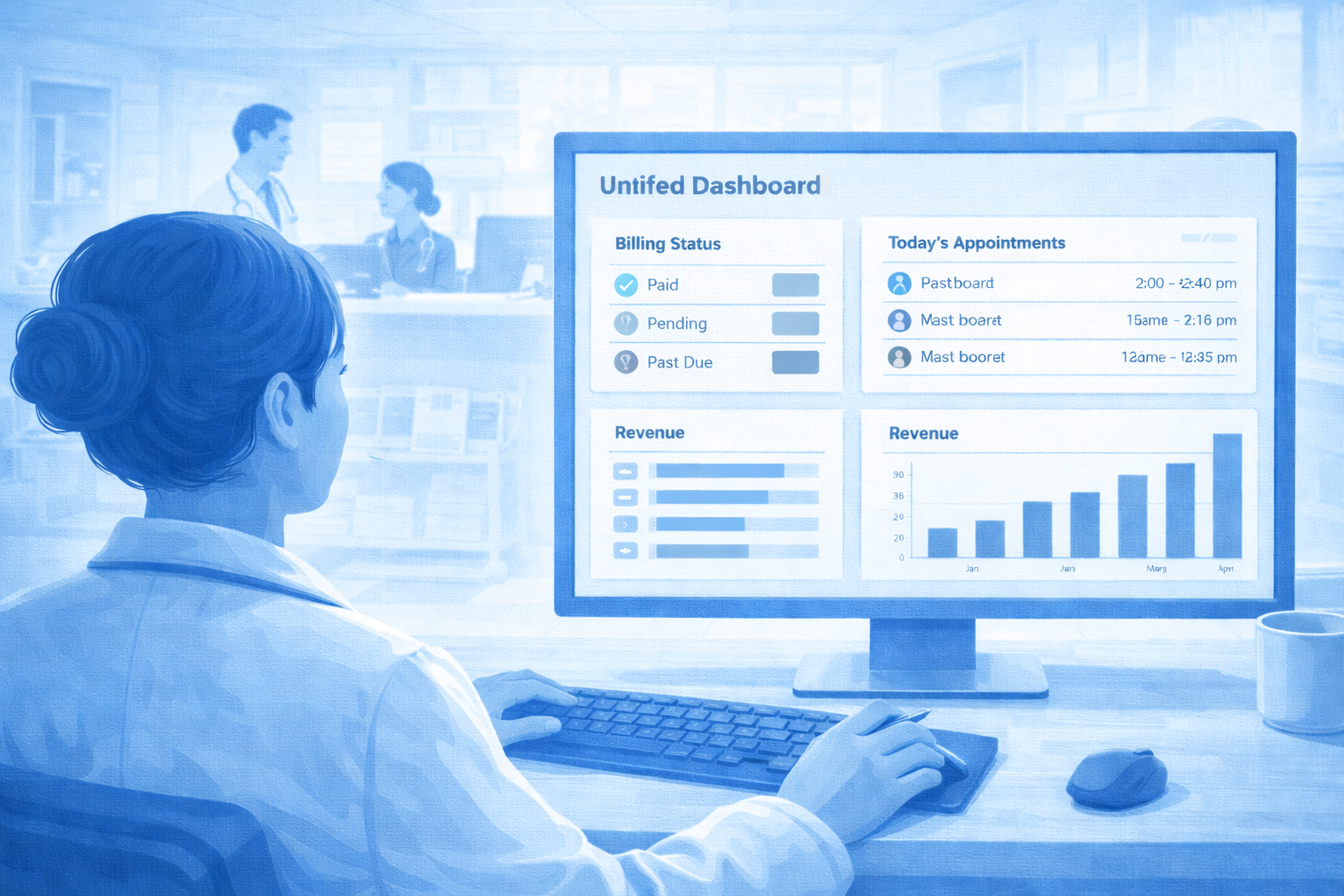
Most clinics aren't choosing between Epic and Oracle. They're trying to figure out whether a single platform can handle billing, scheduling, telehealth, and patient communication — without costing more than it saves or requiring an IT department to operate.
This guide covers the healthcare IT companies worth understanding in 2026: what they actually do, who they're built for, and where they fall short. The comparison table below is designed to give you a fast read before you spend time in a demo.
What Is a Healthcare IT Company?
A healthcare IT company builds software for the operational and clinical needs of healthcare providers — things standard business software isn't equipped to handle. The core difference isn't just functionality. It's compliance. Any system that touches protected health information (PHI) must meet HIPAA requirements by design: how data is stored, transmitted, accessed, and audited.
Beyond compliance, healthcare IT covers four operational categories most practices can't run without:
Clinical documentation — Electronic health records (EHRs) that capture patient history, visit notes, diagnoses, and orders in a structured format.
Revenue cycle management — The end-to-end process of submitting claims, chasing payers, posting payments, and managing denials. According to the American Medical Association, practices lose between 5% and 11% of net revenue to billing inefficiencies, most of which are addressable with better software.
Patient engagement — Portals, messaging, and scheduling tools that reduce front-desk volume and improve patient satisfaction.
Analytics and reporting — Dashboards that surface the metrics that matter: days in AR, denial rate, appointment utilization, payer mix performance.
The right healthcare IT partner doesn't just provide tools. It reduces the administrative drag that pulls staff away from patient care.
How Healthcare IT Platforms Protect Patient Data
Security is not a feature — it's the baseline. Any credible healthcare IT platform builds HIPAA compliance into its architecture, not as an afterthought.
Specifically, this means encryption in transit and at rest, role-based access controls, mandatory two-factor authentication, and continuous system monitoring. It also means a formal Business Associate Agreement (BAA) that establishes legal accountability for how your patient data is handled.
For a deeper look at what AI-specific HIPAA compliance requires, the ENTER AI HIPAA compliance overview covers the current regulatory framework in plain language.
Healthcare IT Companies Comparison: 2026
1. ENTER
ENTER is built for the operational reality of independent practices, community clinics, and mid-sized specialty groups — organizations that need a complete system, not a collection of disconnected tools.
The platform connects clinical documentation, billing, scheduling, telehealth, and patient engagement in one dashboard. That's not just a UX convenience. Every time staff switches between systems, there's a handoff where information drops, steps get skipped, and errors accumulate. ENTER eliminates most of those handoffs.
Key features:
- All-in-one dashboard with patient records, billing status, and appointment views on one screen
- Built-in telehealth — no third-party app required
- AI-powered billing assistant that checks claims for errors before submission, targeting denial prevention at the source
- Patient portal for self-scheduling, record access, and balance payment
What makes it work for small and mid-sized practices: The cost model is consolidated. Rather than paying separately for an EHR, a billing platform, a telehealth tool, and a patient portal, practices pay one price for the full system. For clinics without a dedicated IT department, that also means one vendor, one support line, and one implementation process.
Where it's limited: ENTER is purpose-built for primary care and general specialty practices. Clinics with highly specialized workflows — complex surgical subspecialties, for example — may find some modules need supplementation.
For a detailed breakdown of how the AI billing tools translate to measurable ROI, the CTRL ENTER ROI guide covers the methodology.
2. Epic Systems
Epic is the dominant EHR vendor for large hospital systems and academic medical centers. It's comprehensive, deeply integrated across the care continuum, and genuinely powerful — but it's designed for organizations with the resources to deploy and maintain it.
Key features:
- Full-scope EHR with documentation, order management, and care coordination
- MyChart patient portal, widely adopted and recognized by patients
- AI integrations (Epic Hyperdrive) for ambient documentation and decision support
Strengths: Epic is the industry standard for a reason. Its interoperability infrastructure makes exchanging records with other large systems straightforward, and its breadth of functionality handles complex multi-specialty environments.
Limitations: Implementation timelines measured in years, licensing costs that make it inaccessible for independent practices, and a reputation among clinicians for high administrative burden. The irony of a system designed to improve documentation contributing to physician burnout is well-documented.
Who should use it: Large hospital networks and university medical centers with the infrastructure and budget to support a full Epic deployment. For smaller organizations, the cost-to-value equation rarely works.
3. Oracle Cerner
Oracle Cerner is Epic's closest competitor at scale, with particular strength in government healthcare (including the U.S. Department of Veterans Affairs) and large community hospital systems.
Key features:
- Population health analytics for managing large patient panels
- Integrated revenue cycle management within the EHR
- Cloud migration underway via Oracle Cloud Infrastructure
Strengths: Oracle's cloud investment promises long-term infrastructure improvements. Cerner's analytics tools are genuinely strong for population health management and value-based care reporting.
Limitations: The Oracle acquisition introduced operational friction that's still working through the system — customers have reported slower development cycles and support challenges. The interface remains less intuitive than competitors. Cost is comparable to Epic.
Who should use it: Large community hospitals and health systems with existing Oracle infrastructure or Cerner familiarity. For new entrants, it's rarely the first choice.
4. Innovaccer
Innovaccer occupies a different category than the others on this list. It's not an EHR — it's a data activation layer that sits on top of your existing systems and unifies the information that's otherwise trapped in silos.
Key features:
- Data aggregation from Epic, Cerner, and other source systems into a single patient record
- Analytics dashboard for population health reporting and care gap identification
- Care coordination tools for chronic disease management across provider teams
Strengths: For organizations already running an EHR they're satisfied with but struggling to get actionable data out of it, Innovaccer solves a real problem. It's particularly well-suited for accountable care organizations and practices moving toward value-based reimbursement. As the ENTER guide to healthcare business intelligence software explains, the ability to act on aggregated data — not just collect it — is what distinguishes mature analytics platforms.
Limitations: It requires an existing EHR and adds cost on top of it. Setup requires IT resources. It doesn't touch billing or scheduling.
Who should use it: Organizations with solid EHR infrastructure that need population health analytics or are participating in value-based contracts.
5. Teladoc Health
Teladoc is the largest independent telehealth platform in the U.S., providing the infrastructure and specialist network for health systems to offer virtual care at scale.
Key features:
- Virtual visit platform with high reliability and patient familiarity
- Chronic care management programs for diabetes, cardiovascular disease, and behavioral health
- Broad specialist network enabling virtual consultations across specialties
Strengths: Teladoc has been running virtual care longer than most competitors, and the platform reflects that experience. For health systems that want a large-scale virtual care capability without building it themselves, Teladoc provides ready infrastructure.
Limitations: It operates as a service layer separate from the clinic's primary EHR, which creates workflow friction. Customization options are limited. Some organizations find it feels more like outsourcing care than extending their practice.
Who should use it: Health systems and large group practices with a clear mandate to scale virtual care access quickly.
6. Nuance (Microsoft)
Nuance, now under Microsoft, is the market leader in clinical speech recognition and AI-assisted documentation. Its tools address a specific problem — the documentation burden that's directly linked to physician burnout — rather than practice management as a whole.
Key features:
- Dragon Medical One: cloud-based speech-to-text for clinical dictation
- DAX Copilot: ambient AI that listens to patient visits and drafts clinical notes automatically
- PowerScribe: AI-assisted reporting for radiology and pathology
Strengths: DAX Copilot in particular addresses something that other platforms don't: the time physicians spend on notes after the patient has left. Reducing that directly increases capacity and clinician satisfaction. The Microsoft infrastructure means enterprise-grade security and deep integration with Epic and Cerner.
Limitations: It's a documentation add-on, not a practice management platform. It doesn't touch billing, scheduling, or patient engagement. It adds cost to an existing EHR investment.
Who should use it: Clinics using Epic or Cerner whose physicians are spending excessive time on documentation. If that's the primary pain point, Nuance solves it well.
7. Amwell
Amwell provides a white-label telehealth platform designed for health systems that want to offer virtual care under their own brand rather than routing patients to a third-party service.
Key features:
- Converge platform for provider-led virtual visits
- Digital front door for patient access and navigation
- Interoperability with major EHR systems
Strengths: The provider-led model maintains the clinical relationship in a way that third-party telehealth services don't. Health systems that have invested in their brand experience find Amwell's white-label approach worth the integration effort.
Limitations: Amwell has faced financial headwinds, which introduces questions about long-term platform stability. Integration requires meaningful IT work. The telehealth market is competitive, and the differentiation from Teladoc narrows in practice.
Who should use it: Hospital systems with the resources to integrate a white-labeled virtual care platform and a strong preference for maintaining brand continuity in patient interactions.
8. Cisco Webex Health
Cisco's healthcare offering extends Webex's enterprise communications platform into clinical settings, with an emphasis on security and hardware integration.
Key features:
- HIPAA-compliant video infrastructure leveraging Webex's enterprise reliability
- Device ecosystem integration for clinical settings
- Security and compliance architecture that meets enterprise standards
Strengths: For large health systems that prioritize video call stability, security certification depth, and hardware compatibility, Webex Health is a serious option. Cisco's security track record is strong.
Limitations: It's not a practice management platform, and it doesn't try to be. Scheduling, billing, patient engagement — none of that is here. This is a communication infrastructure tool, not a clinical operations system. Cost is commensurate with its enterprise positioning.
Who should use it: Large health systems building out enterprise communication infrastructure, not clinics looking for practice management software.
How RCM Tools Improve Cash Flow
Regardless of which platform you choose, the revenue cycle management capability is often where the real financial impact shows up.
The core problems are consistent: claim errors that could have been caught before submission, denial rates that go unmonitored, aging balances that nobody is systematically working, and payment posting that takes manual effort. Good RCM software addresses each:
Pre-submission claim scrubbing catches coding errors, missing modifiers, and eligibility issues before the claim goes out. Fewer denials means faster payment and fewer staff hours spent on rework.
Real-time claim tracking surfaces delays immediately rather than letting claims age undetected for weeks before anyone notices they haven't been paid.
Automated patient billing sends balance reminders without requiring front-desk staff to manually manage follow-ups, which tends to increase collection rates at no additional labor cost.
Denial management workflows make it easier to identify denial patterns, correct the underlying issues, and resubmit quickly — before timely filing windows close.
Reporting and analytics give leadership a clear view of which payers pay on time, where denial rates are elevated, and what the AR aging distribution looks like — so problems get addressed before they compound.
Questions to Ask Before Signing a Contract
Before committing to any healthcare IT vendor, these questions will surface the issues that sales calls tend to avoid:
- What is the all-in cost for year one, including implementation, training, and any integration fees?
- Is your software ONC-certified and HIPAA-compliant? Can you provide documentation?
- What does the implementation timeline look like, and what does our staff need to own versus what you handle?
- What is your support model — dedicated account management, ticket queue, or something else — and what are your response time commitments?
- Can you provide three references from practices similar in size and specialty to ours?
- What are the contract terms, and what does early termination cost?
Frequently Asked Questions
What does a healthcare IT company do?
A healthcare IT company builds specialized software for clinical and administrative functions in healthcare settings. This includes electronic health records, billing and claims management, telehealth platforms, patient communication tools, and analytics dashboards. Because this software handles protected health information, it must comply with HIPAA regulations and related federal requirements.
How does healthcare IT software protect patient data?
Compliant platforms use encryption in transit and at rest, role-based access controls, mandatory two-factor authentication, and continuous security monitoring. They also execute a Business Associate Agreement with covered entities, establishing formal legal accountability for how PHI is handled. Staff training is equally important — most breaches trace back to human error, not technology failure.
Can AI in healthcare IT actually save time for clinical and administrative staff?
Yes, when it's applied to the right problems. AI-generated clinical documentation (ambient note-taking during visits) reduces physician time on charting. AI-powered claim scrubbing reduces denial rates. Predictive scheduling reduces no-show rates. The key is specificity — broad claims about "AI" are marketing; specific tools addressing specific problems are worth evaluating.
What should I prioritize when selecting a healthcare IT company?
Start with your primary pain point. If billing is the problem, evaluate RCM tools first. If documentation burden is the problem, look at ambient AI options. If fragmented systems are the problem, look for an integrated platform. After functionality, evaluate support quality, implementation timeline, contract terms, and total cost. References from practices similar to yours are worth requesting.
How quickly can a clinic expect ROI from new healthcare IT software?
Most practices see measurable financial impact within 12 to 24 months — primarily from faster claims payment, reduced denials, and lower administrative labor costs. Integrated platforms that consolidate multiple tools typically produce ROI faster than point solutions, because the savings stack across billing, scheduling, and patient communication rather than appearing in only one area.
References
- American Medical Association — Physician Practice Information: https://www.ama-assn.org/practice-management
- Common medical billing errors and denial prevention: https://azspa.com/common-medical-billing-errors-and-how-to-avoid-them-with-rpm-medical-billing/
- NCBI — Health IT and quality of care: https://www.ncbi.nlm.nih.gov/books/NBK500019/
Related reading:
Results
Sources
About the Author


ENTER is HIPAA compliant and SOC 2 Type 2 certified. See our trust center to learn more.